


Who was given the authority to decide what counts as knowledge?
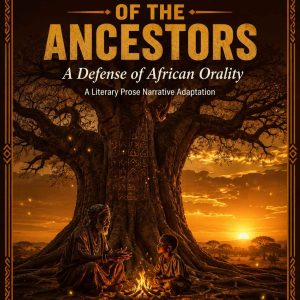
Voices of the Ancestors follows Professor Enongene Mirabeau Sone from the fires and streams of Nkikoh village in Cameroon into the lecture halls of the academy, carrying that question the entire way. It is a defense, not a celebration, and the difference runs through every one of its fifty-seven chapters.
What This Book Is
Voices of the Ancestors is unlike anything else in this catalogue, and deliberately so.
It is a literary prose narrative adaptation of the stage play by Tchinda F. Mbuna. The book does not hide its theatrical ancestry. Arguments arrive as encounters rather than as chapters of exposition, scholarship becomes dialogue, and proverbs act as compressed thought rather than decoration around a more serious argument.
Stage directions have become scene, atmosphere, movement and interior reflection. Transitions once carried by lighting or entrances are expanded so the reader can inhabit the village, the classroom, the university, the road and the lecture hall without requiring a physical stage. What Voices of the Ancestors preserves from the play is its intellectual architecture, entirely intact.
The Question at Its Centre
Every culture develops ways of deciding what deserves to be remembered, who may speak with authority, and what forms of evidence count as knowledge. In many modern institutions those questions are answered so quietly that their assumptions become almost invisible. Knowledge is expected to arrive in print, to be stored in archives, to be stabilised by citation, and to be defended in the language of established disciplines.
Voices of the Ancestors begins from a different threshold. It asks what happens when knowledge first arrives through a grandmother’s story, a proverb spoken at the right moment, a riddle that trains a child to reason, a lineage recited before witnesses, a song carried across generations, or a communal memory corrected in public.
As the prologue puts it, a voice never arrives alone. Long before a scholar stands beneath university lights, other voices have already prepared the ground beneath it. Some belong to teachers, some to grandparents, and some come from fireside stories carried by people who did not require ink to know that they were knowledge.
Why It Refuses to Romanticise
Defending African oral tradition cannot mean declaring every inherited claim true. That is the easier position, and Voices of the Ancestors rejects it explicitly.
A spoken tradition can be corrupted by power, distorted by memory, silenced by hierarchy or reshaped by political interest. Written archives suffer their own exclusions and manipulations. Intellectual fairness therefore requires neither romanticism nor dismissal. It requires disciplined listening.
This is why the recurring question of the narrative is larger than whether oral tradition is valuable. The village is never presented as a place without intellect, nor the university as a place without value. Each teaches a different discipline of attention, and the central conflict emerges only when one system is treated not as different from the other but as naturally superior to it.
The Five Acts
Voices of the Ancestors is built in five movements. Act I, Roots and Awakening, begins at the fire at Nkikoh, a village in the Bangem subdivision of Cameroon’s South West Region, and moves through the girl at the stream, the second school and the first arrival at university. Act II, Formation and Departure, covers two visions of what scholarship is for, the student who asked too much, and the moment when a story becomes a text.
Act III, The Scholar Under Trial, is where Voices of the Ancestors turns. The scholar becomes the subject. A proposal fails. An easier road presents itself and is refused. There is a chapter titled The Woman Who Will Not Be a Footnote, and there is a doctoral defense.
Act IV of Voices of the Ancestors, The Return and the Challenge, addresses the essence of orality, intellectualism redefined, the archive on trial, who is allowed to speak, two lineages on one land, and what the curriculum owes. Act V, The Defense of the Ancestors, is the argument itself, ending in a final defense and a call to action.
What the Book Covers
Across its five acts, Voices of the Ancestors moves from formation through argument to final defense.
- The formation of a scholar, from a village fire to a doctoral defense, across fifty-seven chapters
- African proverbs examined as philosophy rather than as decorative sayings
- Folktales and African folklore treated as moral instruments with genuine pedagogical structure
- Poets and griots, and what praise poetry accomplishes that writing cannot
- Genealogy and testimony as records carrying their own methods of verification
- What power does to a witness, and what memory does to itself over generations
- The archive on trial: which exclusions written records quietly perform
- Who is allowed to speak, and how that permission is distributed by institutions
- What the curriculum owes to knowledge it has historically excluded
- Science, named precisely, and where African oral tradition meets methodological rigour
- Decolonization pillars, argued rather than asserted
- The future of oral traditions inside institutions built without them
- A glossary of African terms, notes on proverbs and translations, and a guide to principal figures
How to Read It
Read Voices of the Ancestors slowly, if you can. This book began life as a stage play and you may still hear it. Dialogue remains central wherever speech carries conflict, scholarship, cultural memory or emotional consequence.
The glossary, the notes on proverbs and the list of principal figures at the back are there to support you rather than to test you. Use them freely rather than treating them as an examination of what you should already know.
Voices of the Ancestors asks you to listen carefully, question what is claimed, ask who has been excluded, and never mistake the absence of ink for the absence of thought.
For wider context on African literature and oral tradition, Britannica’s overview of African literature and UNESCO’s register of intangible cultural heritage provide useful background reading.
Who This Book Is For
Readers come to Voices of the Ancestors from the academy, from the diaspora, and from the villages it describes.
Readers of African literature, students of orature and folklore, and anyone who has wondered why some forms of knowledge require defending while others are simply assumed. It suits those studying decolonial thought, African proverbs and storytelling traditions, and readers from the continent and its diaspora who will recognise the village in these pages.
No prior academic background is assumed. Voices of the Ancestors does not simplify its argument for the reader’s comfort, but it never requires you to have read anything else first.
What Makes It Different
Voices of the Ancestors occupies ground that most writing on this subject avoids entirely.
Voices of the Ancestors argues rather than asserts. Much writing about African oral tradition either celebrates it uncritically or treats it as raw material for anthropologists. This book does neither, subjecting its own case to precisely the standards it demands of others.
The form of Voices of the Ancestors is also unusual. A prose narrative carrying a scholarly argument, where ideas are tested through encounter and consequence rather than through exposition. The result reads as a life rather than as a thesis, while losing none of the intellectual weight of the original play.
And it names its inheritance openly. Voices of the Ancestors is dedicated to Professor Enongene Mirabeau Sone and Professor Kashim Ibrahim Tala, and carries a foreword by Dr. Vivian Nkongmenec. The book belongs, as its dedication says, to them before it belongs to its author.
Professor Sone is Professor of African Literature and Folklore Studies at Walter Sisulu University in South Africa and a Catalyst Fellow of the Centre for African Studies at the University of Edinburgh. He holds a BA, MA and MPhil in African literature from the University of Dschang in Cameroon and a PhD in African oral literature studies from the University of KwaZulu-Natal, and has contributed to The Palgrave Handbook of African Oral Traditions and Folklore. Readers who want to follow his continuing work can find him here.
Continue Your Reading
Browse the full African Literature and Culture collection, or explore the complete Tchinda Mbuna Books library.
Readers drawn to the themes in Voices of the Ancestors often find adjacent value elsewhere in our catalogue. The disciplined listening this book argues for is taught as a practical skill in The Communication Blueprint. The experience of belonging in rooms that were not built for you is addressed directly in The Confidence Code. And for readers examining inherited family and cultural roles, Children Who Control the Family covers how structures shape the people inside them.
About Tchinda Mbuna Books
Tchinda Mbuna Books publishes work that respects the intelligence of its readers, from practical guides you can act on immediately to literary and scholarly writing that asks harder questions. Voices of the Ancestors belongs firmly to the second kind.
How You Get Your Book
Your copy of Voices of the Ancestors arrives instantly. After purchase you will receive an email from BookFunnel with access to your book. Read it online in your browser or in the free BookFunnel app on iOS, Android or desktop. Your copy is personally watermarked to you.
Reviews
There are no reviews yet.