

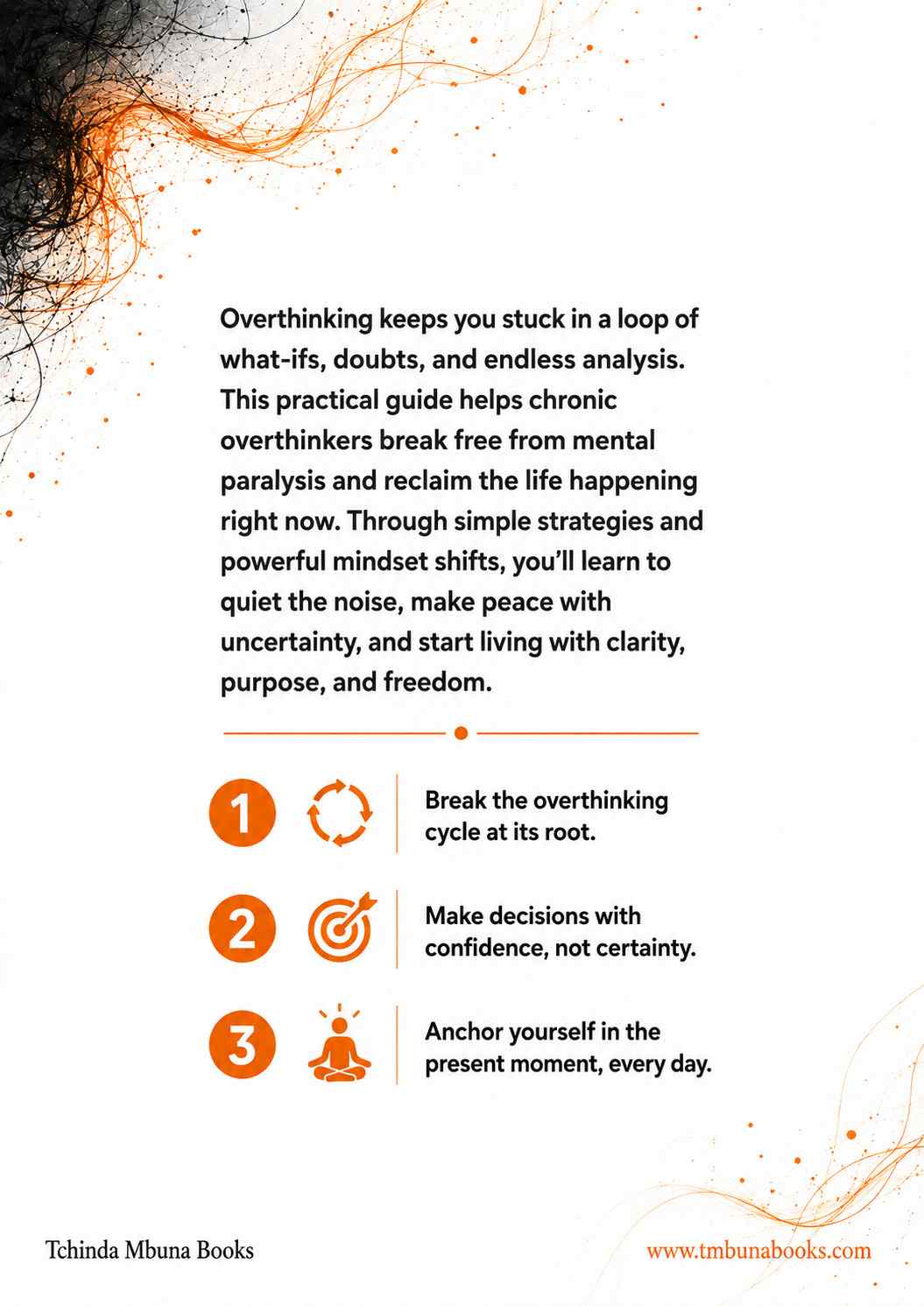
You are not thinking hard. You are thinking in circles.
Rumination feels like problem solving right up until you notice that forty minutes have passed and you have solved nothing. This book teaches you how to stop ruminating by treating the loop as a learned habit rather than a personality flaw.
Is This You?
- You replay conversations from last week, and sometimes from years ago
- You have researched a decision so thoroughly that you can no longer make it
- Your best thinking and your worst thinking happen at exactly the same hour of the night
- You have searched how to stop ruminating while ruminating about whether anything helps
- You mistake worry for preparation and call it being responsible
- You are exhausted by your own mind and would like the volume turned down
Rumination Is Not Thinking
Before any method for how to stop ruminating can work, the loop has to be visible.
Thinking moves toward something. Rumination circles. The difference matters because your brain rewards the circling with a feeling of productivity, which is exactly why the loop is so hard to notice from inside it.
The cycle has five stages: a trigger, the spiral, a false sense of urgency, paralysis, and then self-blame for having spiralled at all. Learning how to stop ruminating means learning to recognise which stage you are in, because each one has a different exit.
What This Book Gives You
This book treats how to stop ruminating as a set of learnable exits rather than an instruction to relax.
Tools rather than reassurance. The core skill is cognitive reframing, taught through a simple old thought and new thought method you can apply to any spiral in about ninety seconds.
Around it sit the practical frameworks: naming the specific distortion driving the thought, a three question filter for decisions, and the seventy percent rule for acting without the complete information you were waiting for.
What You Will Learn
- How to stop ruminating by recognising the five stage cycle as it happens
- The genuine difference between useful thinking and rumination that goes nowhere
- The real cost of constant analysis, framed as motivation rather than guilt
- Cognitive reframing using the old thought and new thought method
- How to name the distortion driving the spiral: catastrophizing, black and white thinking, mind reading
- The three question filter for cutting through analysis paralysis
- The seventy percent rule for making decisions without complete information
- Why the present moment is the only genuine exit from a loop
- Five anchoring techniques, including the five senses method and the next ten minutes rule
- The worry time technique, giving rumination a scheduled slot so it stops colonising the day
- How to stop racing thoughts at the hour when they are loudest
- How to improve mental clarity by changing your relationship with uncertainty
- What causes overthinking to disguise itself as preparation, and how to catch it
- How to stop ruminating thoughts that arrive uninvited during ordinary tasks
- How to protect your progress when stress returns, as it will
How to Use This Book
Read the chapter on the overthinking cycle twice. Most people recognise themselves immediately, and that recognition alone starts loosening the grip before you apply a single technique.
Then pick one tool and use it the very next time you catch yourself circling. Learning how to stop ruminating begins with noticing, and noticing is a skill you can build inside a week.
The Daily Mental Clarity Routine at the back gives you a short daily practice, and the Quick Reference Guide collects every technique in one place for the moments you cannot think clearly enough to find the right chapter.
Guidance on worry and rumination from the NHS and the American Psychological Association covers the underlying research. This book is educational rather than treatment. If rumination is significantly affecting your sleep, work or relationships, please speak with a qualified professional.
Who This Book Is For
People who need to know how to stop ruminating are rarely lazy thinkers. They are usually the most thorough people in the room.
Anyone who analyses every decision to death and still cannot act without certainty. If you want to know how to stop ruminating without being told to simply let it go, which has never once helped anybody, this was written for you.
What Makes This Different
It gives you frameworks rather than encouragement. Most advice on how to stop ruminating amounts to telling you to stop, which is the one instruction a ruminating mind cannot follow.
It also takes decision making seriously as part of the problem. Analysis paralysis is treated as its own chapter with its own tools, because much overthinking is really an inability to act on incomplete information rather than anxiety in the abstract.
And it is honest that the loop will return. The final chapters are about protecting progress when stress comes back, because knowing how to stop ruminating once is different from keeping it quiet long term.
Continue Your Reading
If the circling is mostly worry about the future, Anxiety Relief That Actually Works gives you tools for those moments. If you want a structured daily practice to go alongside this, The Mindfulness Reset is the thirty day companion. And if the overthinking centres on what others think of you, The Confidence Code gets to the root. Browse the full Self-Help and Mindset collection.
About Tchinda Mbuna Books
Tchinda Mbuna Books is dedicated to publishing practical, high-quality guides that respect your intelligence and deliver real results. Every book we publish is built around one promise: information you can act on the same day you read it.
How You Get Your Book
Your complete guide on how to stop ruminating arrives instantly. After purchase you will receive an email from BookFunnel with access to your book. Read it online in your browser or in the free BookFunnel app on iOS, Android or desktop. Your copy is personally watermarked to you.


Reviews
There are no reviews yet.